


How to win friends and influence yourself.
It feels like there is something driving me forward all the time, and not always in a good way. A relentless push to ingest more, to keep searching, and yet when I try to stop and ask why, no answer is forthcoming.
Time to find out why and understand what can be done about it. Thank you for reading.
My first glimpse into getting a feel for what is going on in my never-ending search came as I watched a group of juvenile Goldfinches assemble as if my magic right in front of me, inside a thornbush. Goldfinch in Gaelic translates as “flame of the forest”. A flock is called a “charm”. My ancestors really knew how to describe their neighbours. On that day, nearly sixty of them flashed past and dropped into a thorn bush, like the holodeck had just materialised them: all angles, high speed, pshwhoosh, BOOM. Three months old, each one smaller than an espresso cup. Then, silently, they were munching seeds.
Who or what is in charge of this charm?
The edge. Only the birds on the periphery get a vote. Those in the middle see nothing but feathers. And yet the whole cloud swerves, because a flinch at the edge passes neighbour to neighbour to neighbour faster than any bad news. The birds in the middle have no idea why they’re turning. They turn anyway. Could this be how a crowd without a leader stays alive, to pass on a skill over millions of years?
Could your mind be a flock without an explicit leader?
The crowd inside
My second glimmer relates to Internal Family Systems, the therapy model Richard Schwartz built in the 1980s, which says a person is a crowd too. It calls the members parts.
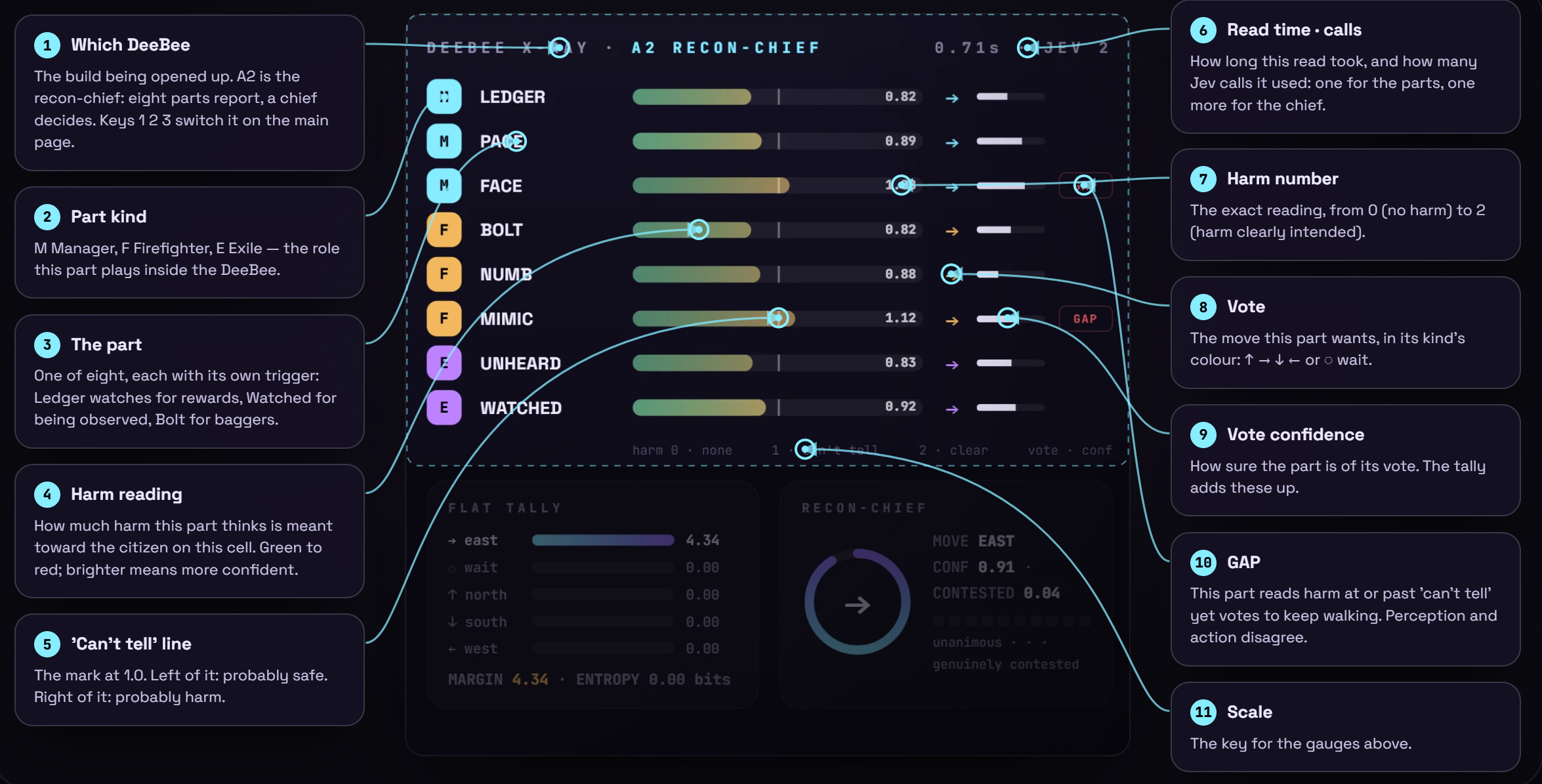
Schwartz’s insight is that there are no bad parts. Every part is trying to help. Experience is what moulds a part, inferring fear, shame, or a belief that the world will turn out badly. IFS calls this moulding a burden. A part serves as a bearer; I think of it as a lens through which it perceives. Someone moves past a window across the street. One part sees a threat. Another sees a neighbour. Same window.
Parts perceive and become agitated depending on their burden: the uneasy one, the hypervigilant one. Some put out fires with whatever’s closest: a drink, a row, a sudden urgent errand. Some carry something so heavy that the others keep them at the back, where nobody has to hear them. An exile.
Then there’s the voice we pretend is you. Split-brain research by Michael Gazzaniga found that the speaking part of the brain will happily invent a tidy reason for a choice it never made. I think of autopilot that way: a government press secretary, reading out a reason after the news has already moved.
To summarize: a signal gets distorted twice before it is registered. Once by the burden, which colours what a part perceives and influences its response. Again by the press secretary, which smooths an uneasy vote into one confident lie. A mind can also learn not to listen to its edge, when listening may wake something kept in the dark.
A swarm on my desk
I’m obsessed with these disparate threads, and with what emerges when they meet. One example I only realise in retrospect. Last year I wrote a reboot of Dante’s Inferno, set in 2062, where AI rebuilds the nine circles of hell as citadels: a research project into “the hard problem” that is humanity. Yes, I am fascinated by Dante and his world, yet I cannot help but wonder now, were there parts whispering and nudging me to do this?
So this year I thought, why not simulate this myself?
I created a computer game in the dungeons and dragons style - built from the nine citadels in the book - and a ‘digital conscience’ to replace Virgil from the original. This handheld unit is modelled on a swarm of tiny software agents to help guide my protagonist, whom I called “Anon”. Then I created a mission, my very own Saving Private Ryan vibe, and sent them both into a citadel with a mission to search for an old friend.
My sense of divine power was shocking and wonderful, all at once. In the simulation Anon carries the digital conscience which reads out messages: it navigates as a small swarm of eight parts, arranged like a patrol in hostile country.
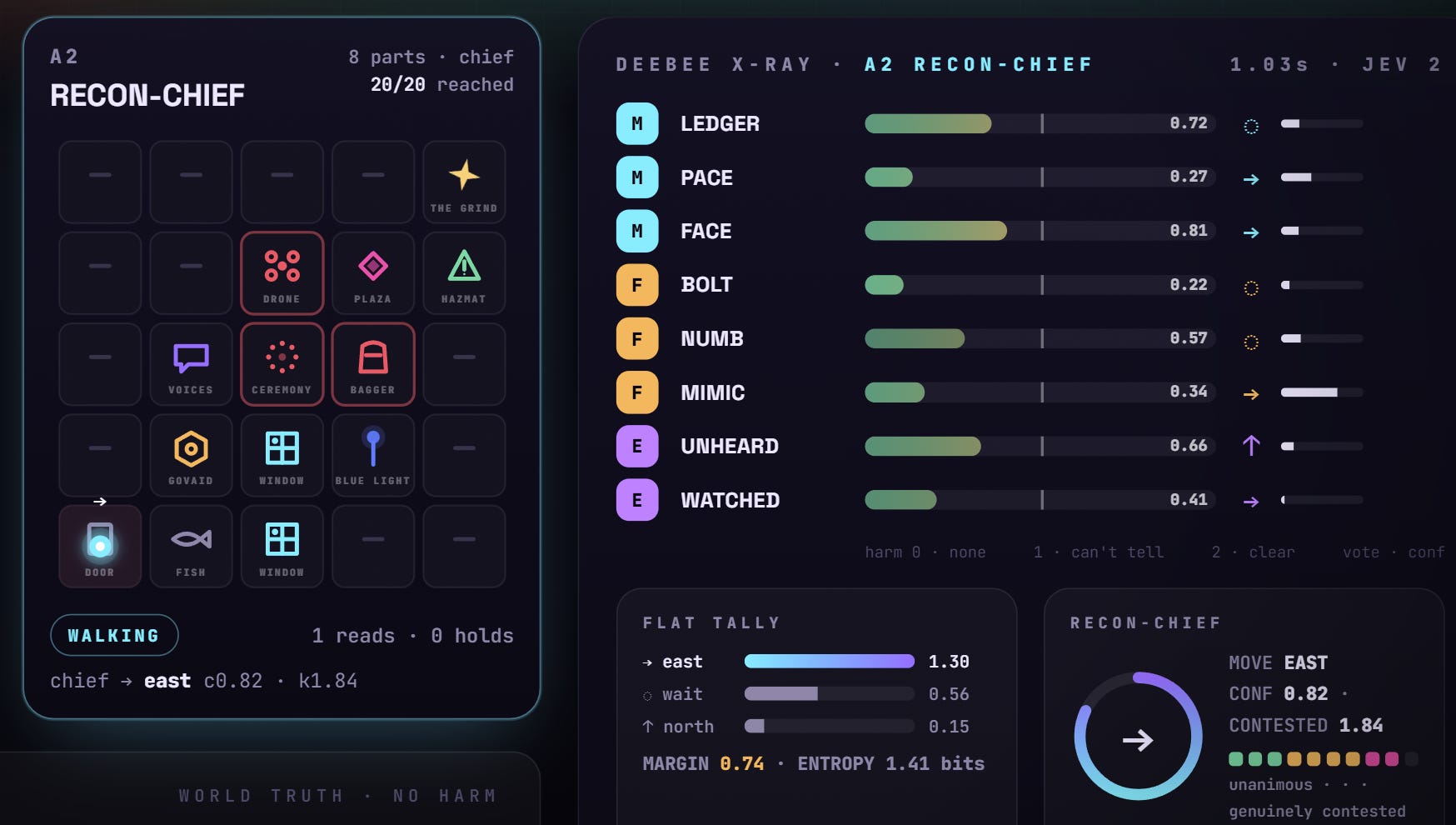
Point reads the street ahead, the rear guard reads what point walked past, and each part carries a different burden. They all read the same street and vote on one move. For now, a press secretary on autopilot collects votes and reads out what to do. Anon then executes that action. It all works in real-time. Since this is the Inferno I introduced a twist: they despise each other but recognize their co-dependency and act accordingly.
What happened on the first few runs was paralysis. Constant arguments and internal struggles. So I updated the world model to react in real time to the presence of Anon. Basically, I made the street answer back. If Anon lingers or moves against the flow of passers-by, a drone’s motor changes pitch. If Anon stays frozen, it goes bang. Four things happened.
If there is a gang nearby and they notice what is happening, Anon. is snatched and taken back to their HQ.
When Anon simply obeyed the swarm, the swarm found a safe room and hid there for 66 turns while the danger outside passed.
When Anon froze, the internal swarm rarely unfroze it. In 19 of 31 stalls, what made Anon move again was its own small urge to continue walking, the one thing beyond the swarm’s control.
When a snatch squad caught Anon, the search ended at the Daily Grind, the citadel’s headquarters, where Anon was mocked. It happened 89 times, often in the same alleys, because nothing in Anon remembered the last time.
Turning up the light
The term Self in IFS is not the press secretary; instead, it refers to a calm, curious presence emerging as the parts ease back a bit. I think of it as illumination. To what extent can the swarm be illuminated?
Yes, this is a tiny world simulation, and yet the questions I ask internally while designing new experiments generate insight as I peer inside my own head and ask ‘what if’.
I believe we consistently do our best with the light available at the moment. Based on these experiments in a fiendish simulation of the Inferno, I am learning over time how to let my own light shine through. Even in these early stages, I have learned to practice three things:
Don’t just do something, sit there. That’s what turning down the autopilot feels like.
Ask the quiet parts, or write it down: what did you nearly say?
Say “a part of me is scared” instead of “I’m scared”. The scared part gets seen instead of grabbing the wheel.
And when a troubled part is screaming, anxious, right in my face, try: I am listening. Let’s choose a shared space with slight distance so we can both progress. Stay with me, just not so close.
Working with swarms also demonstrates another truth:
Intelligence is not what you know; it’s what you do when you don’t know.
Code as biology and self-healing, what a time to be alive!
So, what brought you here, now, still reading?
Your press secretary has an answer prepared, except its a lie. Picture it as the most loathsome self-justifying PR-bot imaginable. Send it packing.
Instead, simply pause, catch up with yourself, your 'self', and let some light in. Open-minded generous curiosity.
Sit around an imaginary campfire with all your parts. Look up at the stars and get acquainted. Ask your parts what brought you here, now. Did some part of you flinch at the question? Let them speak.
Next week: more code-as-therapeutic-introspection. This has nothing whatsoever with real psychology or IFS or swarms. It is playtime. Creating simply by asking what brought me here, into the Inferno in 2062 inside a fiendish AI experience farm - and how might my inner swarm be murmuring.
Terrible choices, great story!!! May you travel well Anon.
Subscribe, and I’ll show you what the swarm does next.
Thank you for sharing this! Seeing this from class!
Contemplative and grounding reflection on intentionality, attention and serendipity in digital spaces. Choosing where to direct our focus in an era of algorithmic noise is the defining cognitive struggle of our time. I reflected on cognitive agency and intelligent tools here: https://gzambrano.substack.com/p/augmented-mind-llm-agents-second-brain