


I was around 23 years old when I realized that a problem is actually a gift, even though it requires many, many years of solid work for no obvious reward. That was the first time I realised that I must have something to push against really, really hard. There has to be a felt sense of resistance… otherwise it's almost impossible for me to get anything done.
Over the ensuing decades this discovery has been repeated and strengthened many times both inside my head and out, especially from Steven Pressfield (The War of Art) and Byron Katie (The Work).
The scourge of 'solutions'
In order to grow, you need a problem. Not an auto-correct, or a solution. Let me expand a little. For me, a problem has four phases. Each one can take anything from 18 to 24 months to really nail down.
Phase One: Clearly identifying what my problem really is. Anything identifiable in anything less than about 18 months of digging and scratching is not a real problem to be honest. Either it is 'life' or my own bad behaviour.
Phase Two: The search widens, my circle expands to see what's already out there, to find my tribe of fellow sufferers, find where the gaps are.
Phase Three: Time to lean in, double down, make the calls, iterate the prototype, socialise what a solution might look like.
Phase Four: is the golden zone where I get to bask in profit and glory, the satisfaction… even though it has taken me up to a decade to get here.
All of this is theory of course, but the overall shape is what matters.
A Hamlet of Problems
I'm truly blessed to have been granted more than one problem of the type above over the course of my 60-odd years on this planet. This short essay is about problem no. 2, I'll come back to the first one another day.
For the five-year-old in me, this is the problem stated clearly:
We have lots of parts in our brains to make them work - like the Numbskulls in my Beezer comic, or Pixar's Inside Out. So how do they communicate?
There is a whole mush of parts, right? How do messages move between those parts? That's my problem. It can't be based on vision, because blind people are extremely intelligent. The same goes for the deaf, and so on, for all our hundreds of senses.
How awesome would it be if the answer was 'through the medium of dance'. Or scent? I am not kidding here. There may be a chemical gradient that codes the messages, so what can it possibly be? I suspect there does need to be a somatic, felt-sense of something. I have spent several decades in telecoms and data systems and biomechanics and AI and so on, yet I am totally clueless about what the answer may be. In summary, Mark Solms proposes a feeling; Anil Seth suggests a seed; Michael Levin is focussed on non-neural bioelectricity.
So, yes, I have a problem.
Anyone for Dante?
My tribe - those who have taken on the same problem - goes back eons. One of the greatest is worth a moment, because he took a very nuanced take seven hundred years ago and it's time everyone took notice again.
Dante wrote the Commedia in Tuscan when the accepted practice was to write in Latin. He took another path (we will circle back on this in future posts). He wrote in his native dialect, in a new metre, of such magnificent form and cadence that the poem reached people who had never been able to read a book before. People learned the dialect so as to immerse themselves deeper in his world. I come from a telecoms and signals background, so I'd say he changed the carrier so a different brain could receive the signal.
He also got away with it because of Virgil. His guide needed no introduction. Listeners already knew the poet who walked Aeneas through the underworld, so Dante could start at the second storey. The guide was inherited. It came free with the culture.
His work is stunning, but who would get the role of Virgil in a reboot, and why?
Nine circles as a research method
The Inferno is not a punishment fantasy. It's a survey. Nine circles, each one asking a question: what becomes of the emotionally incontinent? What happens to those who choose to organise their entire life around a particular appetite? Once I started to work my way through translations and notes and talks, I could not look away. Whatever you believe about the theology, the shape of the thing is a research instrument (and a way for him to settle scores, but I digress): This is social graphs on an epic scale:
This is Hell as an Algorithm.
A year or so after I emerged from the depths, I realised his work was exactly what I needed. My problem is that I cannot see how messages translate or morph between the parts of a mind. So I did what Dante did. I wrote a place where the question has to stand still and be looked at.
What if AI reads the Inferno and decides it constitutes a splendid research lab?
The re-boot
I wrote, and am still writing, a reboot of Dante's Inferno. Nine citadels instead of nine circles, and Virgil replaced by a digital conscience: a device that mediates between the person and the machine world, between the machine and the person.
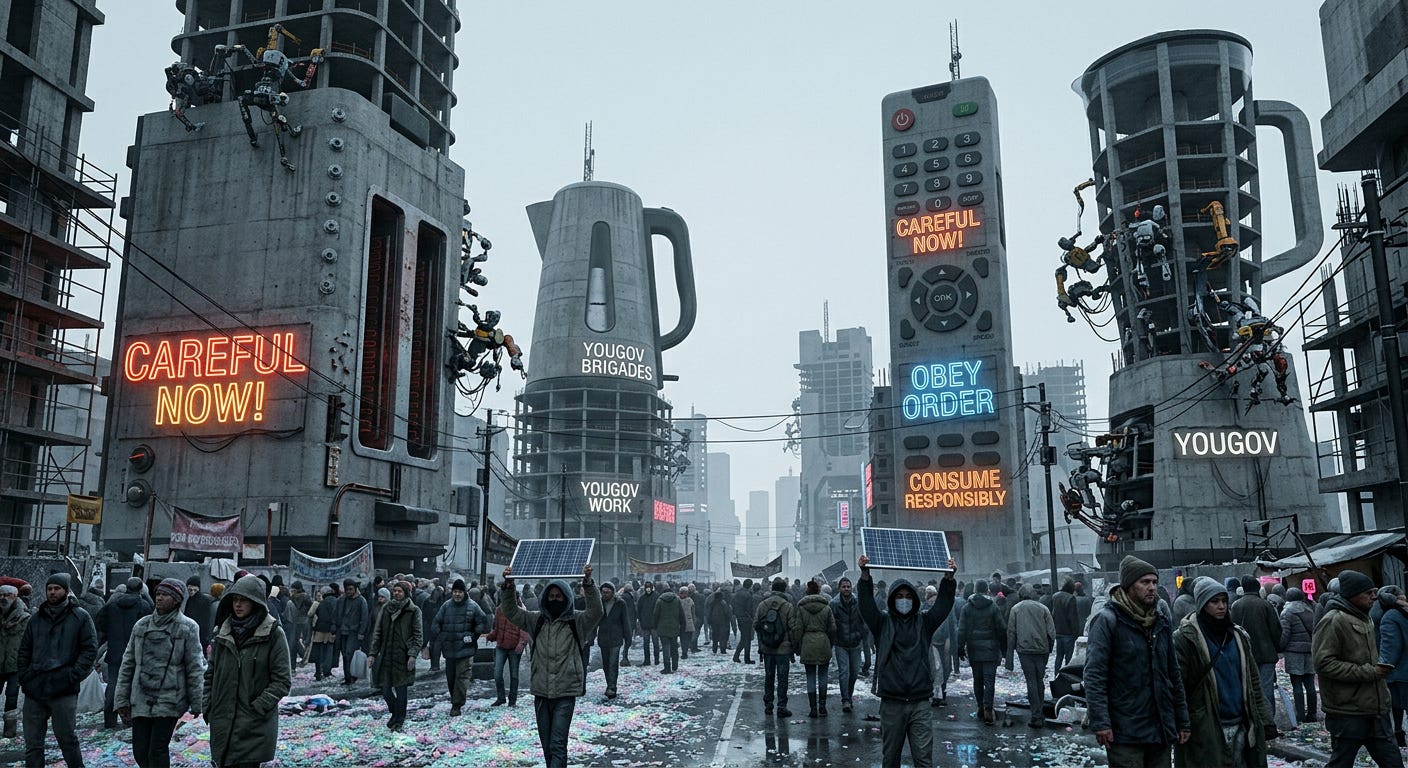
Virgil's whole power lies in authority, reason, beauty, wisdom. He explains, rebukes, and walks ahead, yet he cannot enter Paradise. He is barred for being born before the good news arrived. A guide who cannot arrive where he is taking you.
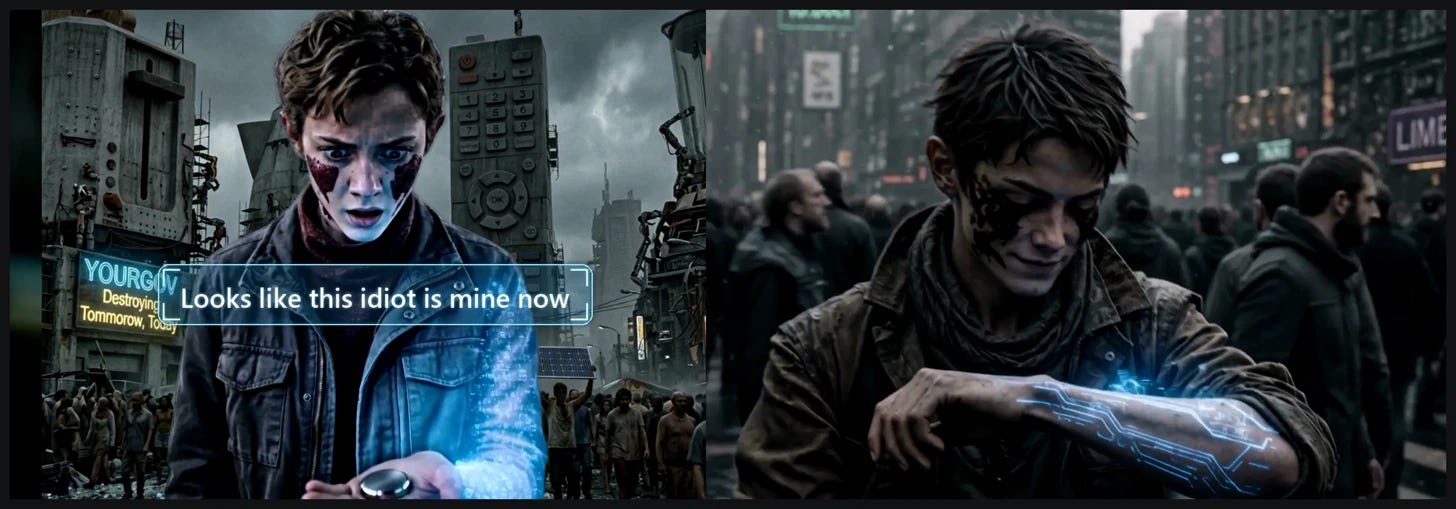
His role replacement has no such problem. I give his replacement a sub-dermal 4K OLED display for the skin of the forearm that creates dazzling text and images. Virgil could only talk, but his replacement has a needle. Several thousand velcro-like needles to deliver a subtle blend of chemical nudges should the human host require more persuasion.
Why? It may help to make the invisible, visible. The logs may be made visible, at least in fiction and in simulation, to separate important state variables and open new channels of communication into the brain. I can see the tagline already:
Terrible choices, great story!
Writing book I of the series has been an extraordinary experience. What is even better for me and my problem is the opportunity it presents for debate, for inquiry and new forms of expression. My thinking continues to evolve - except now I get to hold debates with the characters in the books. I get their feedback on new scenes, on moral choices, and I can summon replicas laden with their texts from centuries past. Only today I got this diamond from one of the Elders in Limbo.
"The person's relationship to the device is not advisory but metabolic. You cannot reassess your relationship with something that is also your heart."
I look forward to publishing more outputs of the debates, the moral hazards and encounters to reflect on.

Which phase am I in?
Phase Three. Leaning in, working the prototype, socialising what a solution might look like. Stepping up to write with the door open and publish every day for thirty days is part of this, and you are a vital part of the socialising.
I said at the start that a problem is a gift, and every gift exacts a price. That price is slowly coming into focus now. I have been at this one for years and I still cannot tell you how the parts of a mind communicate. My gut feel tells me that neuro-modulators and cytokines (oh my!) play a key role, but I am settling in to another decade or so of exploration. I have even built a simulation of the citadels and this prototype digital-conscience to watch eight of them argue, and I still cannot tell you.
Which brings me back to the title. Once you have a problem, it is extraordinary company: I hold debates with my own characters, I summon Elders who have been dead for centuries, and I get new challenges presented almost every day.
Over the coming weeks, I will cover these topics in more detail, and if you have a problem, congratulations and good luck.